


Construction Waste Recycling in Saudi Arabia: Turning a Cost Line Into Recovery
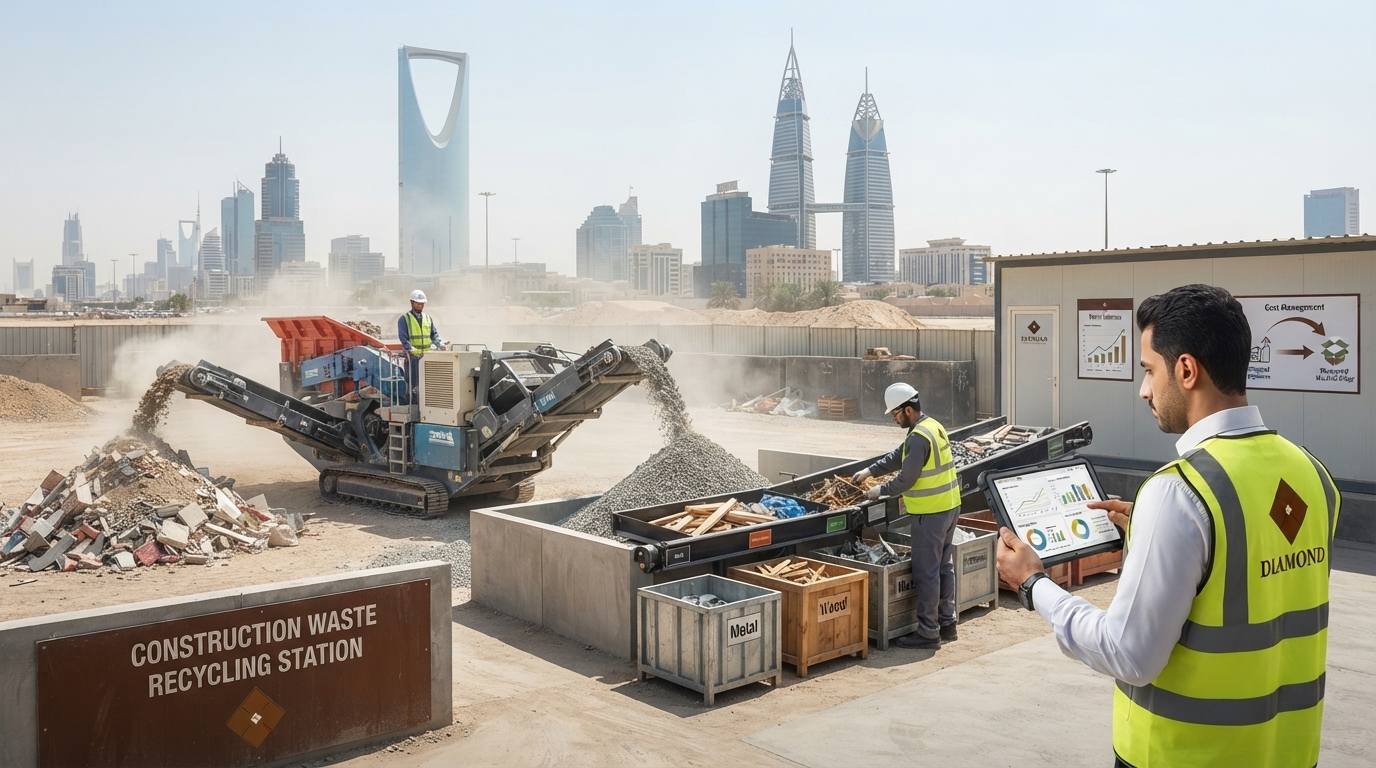
Your project budget shows a single figure for waste disposal. Nobody knows what proportion of that skip volume was clean concrete, recoverable steel, or genuinely unusable material. Mixed skips get charged at the highest rate regardless of content. Construction waste recycling in Saudi Arabia starts by separating streams on site, before anything reaches a truck.
Why Construction Waste Recycling in Saudi Arabia Now Matters
Construction and demolition waste makes up a substantial share of total waste volume in most developing urban markets, and Riyadh's building programme generates it continuously.
Landfill capacity carries a real cost. Disposal fees rise as sites fill, and haulage distance grows as nearby facilities reach capacity.
Policy direction has shifted too. The Saudi Green Initiative and the circular economy targets under Vision 2030 push recovery up the agenda, and the National Center for Waste Management regulates the sector accordingly.
Client requirements follow policy. Large developers and government projects increasingly write diversion targets into tender documents, so contractors without a recovery plan lose points at bid stage.
Construction waste recycling in Saudi Arabia also protects margin directly. Recovered steel and clean aggregate carry value, while mixed waste carries only cost.
What Actually Comes Out of a Demolition Site
Knowing your material mix determines what recovery is worth attempting.
Concrete and Masonry: Usually the largest fraction by weight. Crushed concrete produces recycled aggregate suitable for sub base, backfill, and site roads. Crushing on site avoids double haulage costs entirely.
Steel and Metals: Reinforcement bar, structural sections, ductwork, cabling, and pipework. Metals hold the strongest resale value of any construction stream, and separating them is straightforward.
Timber: Formwork, pallets, and packaging. Clean untreated timber can be reused or processed. Treated and painted timber needs separate handling.
Gypsum and Plasterboard: Requires separate handling because gypsum in mixed landfill conditions can generate hydrogen sulphide. Keep it dry and separate.
Plastics and Packaging: Pipe offcuts, membrane, insulation packaging, and shrink wrap. Volume is high relative to weight, so containerise it early or it fills your skips.
Hazardous Materials: Asbestos containing materials in older buildings, contaminated soil, paints, solvents, adhesives, and batteries. These need licensed specialist handling and full documentation. Survey before demolition rather than discovering them mid works.
Excavated Soil: Frequently the largest volume overall. Clean soil often finds use as fill on the same or a nearby project, which removes both disposal and import costs.
On Site Segregation Beats Off Site Sorting
Once materials mix, recovery value drops sharply and sorting costs rise. Separation at source is where construction waste recycling in Saudi Arabia succeeds or fails.
Plan waste areas at mobilisation, not after the first skip overflows. Allocate space near the works, accessible to trucks, with clear signage in Arabic and English.
Use dedicated containers per stream. Colour code them and label them with both text and images, since site labour includes multiple language groups.
Position containers close to where waste is generated. Every additional metre a worker must carry material reduces compliance.
Brief subcontractors in their induction and write segregation duties into their contracts. Without contractual obligation, subcontractors default to the nearest available skip.
Sequence demolition to help separation. Soft stripping before structural demolition removes fixtures, timber, gypsum, and metals cleanly, while mechanical demolition afterward produces a relatively pure concrete stream.
Appoint one site person as waste coordinator with named responsibility. Programmes without an owner degrade within weeks.
Track tonnage by stream weekly and post the diversion rate on the site notice board. Visible measurement drives behaviour on site far better than policy documents. That feedback loop is central to construction waste recycling in Saudi Arabia working at project scale.
Regulation and Documentation
The National Center for Waste Management licenses waste service providers and regulates handling and disposal. Verify licences directly rather than accepting a scanned certificate.
Riyadh Municipality applies additional requirements around approved disposal locations, transport routes, and site conditions. Fly tipping penalties fall on the project, not only on the haulier.
Maintain a waste transfer record for every load. It should show the material type, quantity, carrier details, destination facility, and date.
Hazardous waste needs a separate, stricter record trail with disposal certificates from licensed facilities.
Keep these records from day one. Green building certification submissions, client audits, and any regulatory inquiry all request them retrospectively, and reconstructing records after the fact rarely works.
Choosing a Contractor for Site Waste
Ask where each stream goes after collection. A serious contractor names the recovery or disposal facility for every material.
Ask whether they provide on site crushing, since processing concrete in place removes significant haulage cost on larger demolition projects.
Ask for a sample tonnage and diversion report. If they cannot produce one, they are not measuring recovery at all.
Ask about container availability during peak phases, because delayed exchanges stop work and encourage mixing.
Partnering with an established provider of Waste Management Riyadh projects rely on gives you licensed transport, documented disposal, and reporting under one contract rather than coordinating several hauliers.
Check that their hazardous waste capability is genuine, not subcontracted without your knowledge.
Frequently Asked Questions
What percentage of construction waste can realistically be recovered?
It depends heavily on segregation discipline and building type. Concrete, steel, and clean excavated soil are the easiest wins and typically make up most of the recoverable volume. Projects that segregate at source consistently achieve much higher diversion than those relying on off site sorting of mixed loads.
Does recycling construction waste actually save money?
It can, through three routes: lower disposal tonnage charges, resale value from metals and timber, and avoided purchase of imported fill when crushed concrete or excavated soil is reused on site. The saving depends on project scale and how early segregation begins.
When should hazardous materials be surveyed?
Before demolition begins. A pre demolition survey identifies asbestos containing materials, contaminated soil, and other hazardous items so they can be removed under controlled conditions. Discovering them mid works stops the programme and costs far more.
- Monuments historiques
- Restaurant Traditionnel
- التعليم
- Mode
- Formation
- Information
- Restaurant
- culture
- تسويق
- Tourisme
- سياحة
- تنمية
- Découverte
- Art
- Causes
- Crafts
- Dance
- Drinks
- Film
- Fitness
- Food
- الألعاب
- Gardening
- Health
- الرئيسية
- Literature
- Music
- Networking
- أخرى
- Party
- Religion
- Shopping
- Sports
- Theater
- Wellness
 Arabic
 English
 French
 Spanish
 Portuguese
 Deutsch
 Turkish
 Dutch
Dutch
 Italiano
 Russian
 Romaian
 Portuguese (Brazil)
 Greek
Greek