
Preventive Building Maintenance in Riyadh: Stop Paying Twice for Every Failure
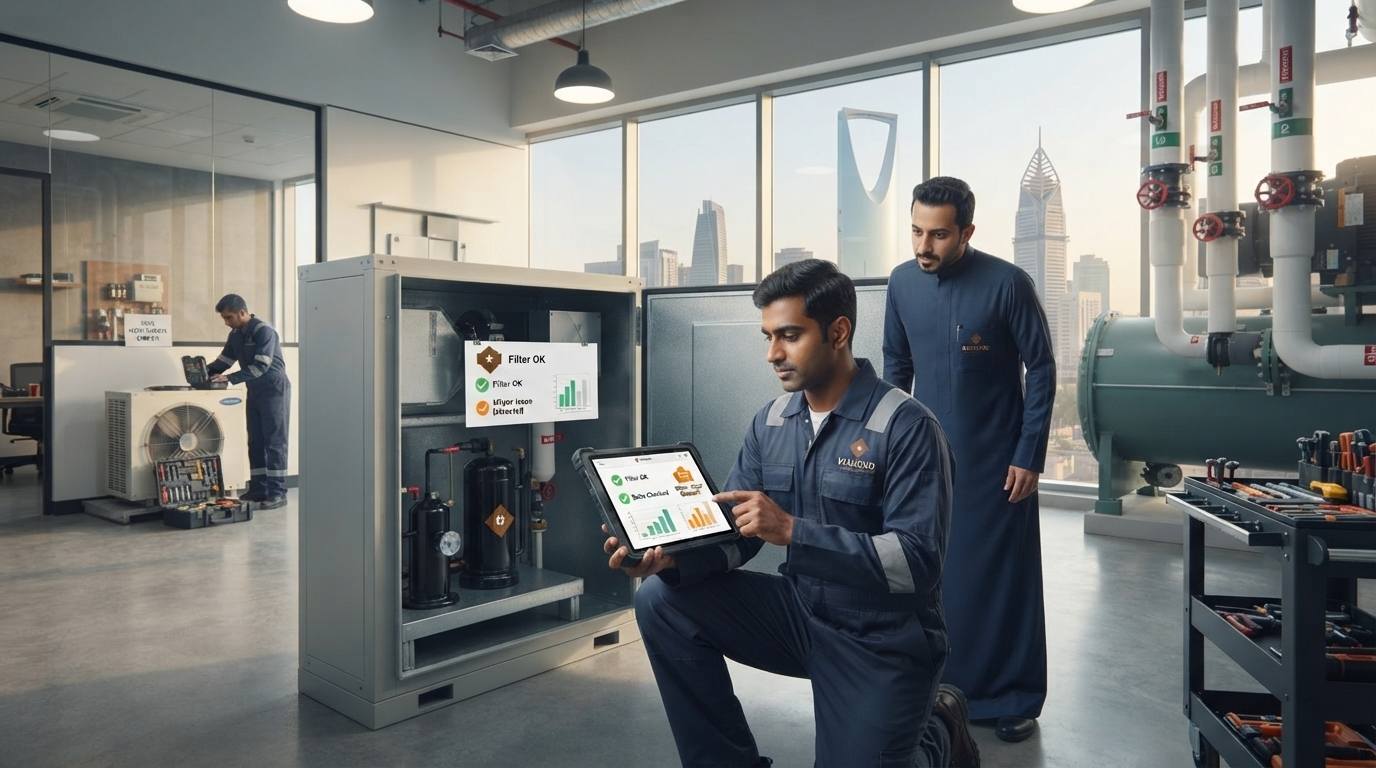
The chiller fails in July. You pay emergency callout rates, rent temporary cooling, and compensate two tenants for lost trading. The repair itself was the cheapest part of the week. Buildings that wait for failure pay for the same asset twice. Preventive building maintenance in Riyadh replaces that pattern with scheduled work you can budget, staff, and plan around.
Why Preventive Building Maintenance in Riyadh Beats Reactive Repair
Reactive work carries a premium on every line. Emergency labour costs more, expedited parts cost more, and unplanned shutdowns cost tenants directly.
Assets also age faster under reactive management. A pump running with worn bearings damages its shaft. A filter left dirty forces the fan motor to work harder until it burns out.
Planned work protects warranty positions too. Manufacturers frequently require documented servicing intervals, and missing records weaken any claim.
There is a tenant retention angle that owners underestimate. Occupiers renew leases in buildings that stay comfortable and functional, and they leave buildings where lifts stall and cooling drops.
Preventive building maintenance in Riyadh converts unpredictable emergencies into a known annual cost. That predictability is what finance teams value most.
The Asset Register Comes Before the Schedule
You cannot maintain equipment you have not listed. Most buildings discover this the first time they attempt a proper programme.
Walk every plant room, roof, riser, and service area. Record each asset with its make, model, serial number, capacity, installation date, and location.
Add condition ratings on a simple scale. A five point scale from new to end of life is enough, and consistency matters more than precision.
Attach documents to each record. Manuals, warranty certificates, commissioning reports, and previous service history all belong in one accessible place rather than scattered across email threads.
Then rank assets by criticality. Ask what happens if this item stops. A main chiller, fire pump, or lift sits at the top. A pantry water heater sits far lower.
Criticality drives everything downstream. It sets inspection frequency, spare parts holdings, and response times. Preventive building maintenance in Riyadh works when high risk assets receive attention proportional to the consequence of their failure.
Which Systems Fail First in Riyadh Buildings
Climate shapes the failure pattern here, and the sequence is fairly consistent across commercial properties.
HVAC and Chilled Water Systems: Cooling equipment runs at high load for extended months. Condenser coils clog with dust, refrigerant charge drifts, and compressors work near their limits. Clean coils quarterly, check refrigerant pressures before summer, and test control valves rather than assuming they modulate correctly.
Water Systems and Tanks: High temperatures encourage bacterial growth in stored water. Tanks need scheduled cleaning, disinfection, and inspection of covers and vents. Scale builds quickly in hard water and reduces heat exchanger efficiency.
Roofing and Waterproofing: Sustained UV exposure and thermal cycling degrade membranes and sealants. Inspect roofs twice yearly and before any rain season, paying attention to flashing, drainage outlets, and penetrations.
Facade and Glazing Seals: Expansion and contraction loosen sealant joints, which allows dust and water ingress. Silicone joints have a finite service life and need planned replacement.
Electrical Distribution: Dust inside enclosures insulates components and reduces cooling. Thermal scanning before summer catches loose terminations while shutdown windows remain practical.
Lifts and Escalators: Dust ingress affects door mechanisms and guide systems. Follow manufacturer intervals rather than stretching them, because lift repairs escalate quickly.
Sequencing your year around this list is the practical core of preventive building maintenance in Riyadh. Heavy inspection work belongs in the cooler months.
Building a PPM Schedule That Crews Actually Follow
Start from manufacturer intervals, then adjust for local conditions. Dust and heat generally justify shortening intervals rather than extending them.
Distribute tasks across the year so workload stays level. A schedule that concentrates half the annual work into two weeks will not be completed properly.
Write task instructions as checklists with measurable outputs. "Service AHU" means nothing. "Replace filters, record differential pressure, check belt tension, log fan current draw" produces data you can trend.
Use a CAFM or CMMS system to issue and close work orders. Spreadsheets collapse once you pass a few hundred assets across multiple buildings.
Track completion rate as a headline metric. Any programme completing below ninety percent of scheduled tasks is drifting back toward reactive work.
Review trend data quarterly. Rising current draw, falling flow rates, and increasing vibration all predict failures months before they happen, which is the entire purpose of preventive building maintenance in Riyadh.
What to Put in a Maintenance Contract
Define scope by asset, not by vague system name. Ambiguity always resolves in favour of the party who wrote the contract.
Specify response times by priority level, with separate targets for emergency, urgent, and routine work.
Require monthly reporting that includes completed tasks, outstanding items, condition changes, and recommended capital works.
Clarify what sits inside the fee and what gets charged separately, particularly consumables, spare parts, and specialist subcontractors.
Engaging a provider that delivers integrated Building Maintenance Services avoids the coordination gaps that appear when HVAC, electrical, and plumbing sit with three separate contractors blaming each other.
Include handover terms so asset data, work history, and documentation remain your property when the contract ends.
Frequently Asked Questions
How much should a building budget for annual maintenance?
Budget as a percentage of asset replacement value rather than guessing from last year's spend. Older buildings and equipment nearing end of life need a higher allocation. Include a separate capital replacement fund, because planned maintenance extends asset life but does not eliminate replacement.
What is the difference between planned and preventive maintenance?
Planned maintenance covers any scheduled work, including planned replacements. Preventive maintenance specifically aims to stop failures before they occur through inspection, servicing, and condition monitoring. Preventive work sits inside the wider planned programme.
How do I know if my current contractor is performing?
Look at three measures: percentage of scheduled tasks completed on time, number of reactive callouts per month, and whether reactive callouts are falling over time. A contractor whose emergency work stays flat year after year is not preventing anything.
- Monuments historiques
- Restaurant Traditionnel
- Образование
- Mode
- Formation
- Information
- Restaurant
- culture
- تسويق
- Tourisme
- سياحة
- تنمية
- Découverte
- Art
- Causes
- Crafts
- Dance
- Drinks
- Film
- Fitness
- Food
- Игры
- Gardening
- Health
- Главная
- Literature
- Music
- Networking
- Другое
- Party
- Religion
- Shopping
- Sports
- Theater
- Wellness
 Russian
 English
 Arabic
 French
 Spanish
 Portuguese
 Deutsch
 Turkish
 Dutch
Dutch
 Italiano
 Romaian
 Portuguese (Brazil)
 Greek
Greek