


Can DIY Radon Removal Service Reduce Radon Levels Safely?
Radon is a naturally occurring radioactive gas that can enter homes through cracks, gaps, sump pits, and other openings connected to the ground. Because it is invisible and has no smell or taste, testing is the only reliable way to determine whether a home has elevated radon levels. Health Canada recommends corrective action when the annual average radon concentration in a normal occupancy area exceeds 200 Bq/m³.
For homeowners searching for a diy radon removal service, it is important to understand which tasks can reasonably be handled independently and which require professional expertise. While homeowners can test for radon themselves and take some preventive measures, installing a complete mitigation system is a more technical process.
What Does DIY Radon Removal Involve?
A DIY approach generally begins with testing the home. Health Canada recognizes do-it-yourself radon test kits as an option and recommends a long-term test lasting at least three months for a more representative measurement.
After testing, homeowners may inspect areas where radon could enter, such as:
- Foundation cracks
- Gaps around pipes and utility lines
- Floor drains
- Sump pits
- Crawl spaces
- Joints between walls and floors
Sealing obvious openings can help reduce radon entry, although sealing alone may not adequately address a high radon concentration. Health Canada notes that sealing entry routes and improving ventilation can help, but their effectiveness depends on the home's design and the level of radon present.
Why Is Radon Mitigation More Complicated?
Radon removal is not simply a matter of sealing every visible crack. Soil beneath a home can contain radon, and pressure differences can draw the gas indoors. A properly designed mitigation system addresses the source by creating a controlled pathway for radon to leave the building.
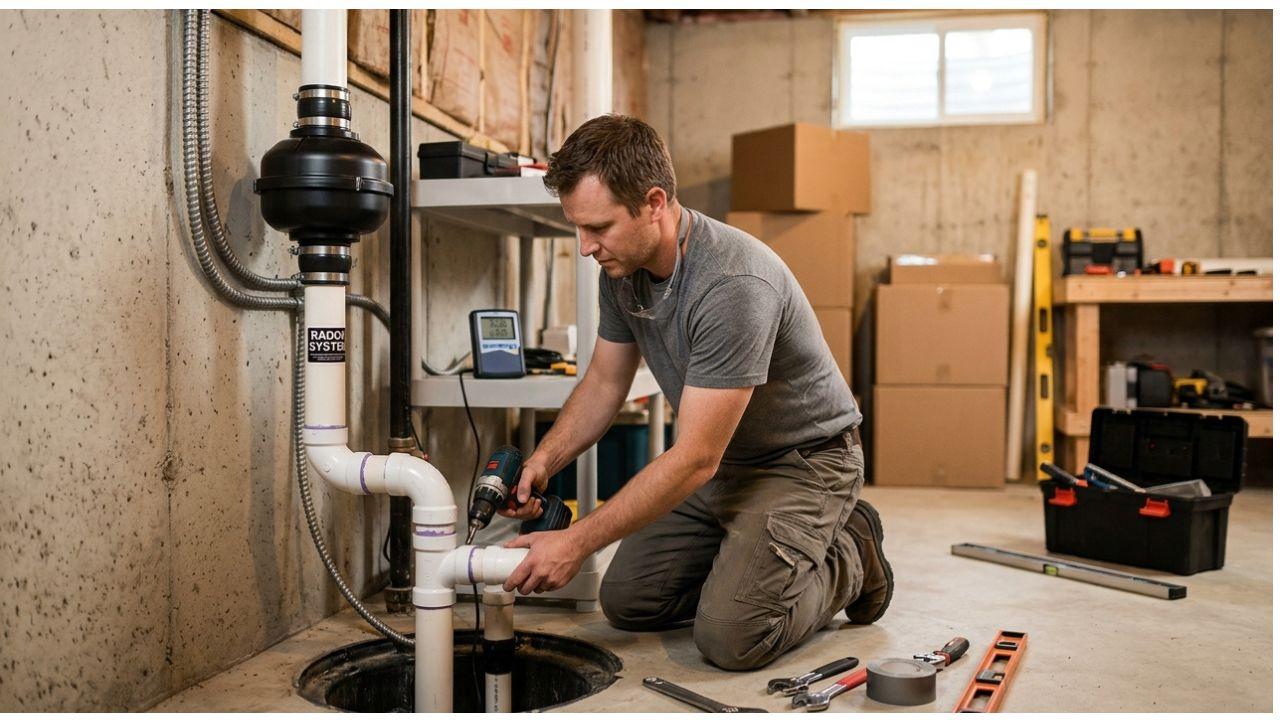
The most common professional technique is active soil or sub-slab depressurization. It uses a pipe and fan to draw radon-containing air from beneath the foundation and exhaust it safely outdoors.
Installing such a system may involve drilling through a concrete slab, determining the appropriate suction point, routing ventilation piping, installing a fan, and checking system performance. Incorrect installation can result in inadequate radon reduction or other building concerns.
What Can Homeowners Safely Do Themselves?
A DIY radon removal service approach can be useful for preliminary steps. Homeowners can purchase an appropriate long-term test kit, follow the manufacturer's instructions, inspect accessible foundation areas, and seal suitable small openings with appropriate materials.
They can also improve general ventilation where appropriate. However, ventilation should not be treated as a replacement for professional mitigation when radon levels are significantly elevated. Health Canada reports that balanced ventilation systems can reduce radon, but they are generally less effective than active soil depressurization.
Most importantly, homeowners should retest after making changes. A mitigation effort should be judged by measured radon levels rather than by whether the installation appears complete.
When Should You Consider Professional Help?
If a long-term test shows an annual average above 200 Bq/m³, Health Canada recommends hiring a radon mitigation professional certified through the Canadian National Radon Proficiency Program.
Professional assistance is particularly useful when radon levels are substantially elevated, the home has a complicated foundation, there is a crawl space or multiple foundation levels, or a previous DIY attempt has not reduced the readings sufficiently.
A qualified professional can evaluate the building, identify likely entry routes, select an appropriate mitigation strategy, install the necessary equipment, and recommend follow-up testing.
How Can DIY Efforts Complement Professional Mitigation?
DIY maintenance does not necessarily have to compete with professional radon mitigation. Homeowners can remain involved by monitoring radon levels, keeping the mitigation fan and visible components in good condition, maintaining suitable ventilation, and following recommended retesting schedules.
Health Canada's current guidance recommends testing again after mitigation and continuing periodic testing to confirm that the system remains effective.
About Ottawa Radon Pro
For homeowners in Ottawa looking for information about radon testing and mitigation, Ottawa Radon Pro provides a dedicated resource at https://ottawaradon.pro/. Homeowners can explore the available information and learn more about approaches to identifying and addressing radon concerns. If you need additional information about radon services in Ottawa, you can visit out website for more details.
Conclusion
A diy radon removal service approach can be useful for testing, identifying potential entry points, and taking basic preventive measures. However, elevated radon often requires more than sealing visible cracks or increasing ventilation. Professional mitigation systems, particularly active soil depressurization, are designed to remove radon from beneath the home and vent it outdoors.
The most practical approach is to test first, understand the results, and use qualified professional assistance when mitigation is necessary. Regular follow-up testing can then confirm whether radon levels have been reduced effectively.
- Monuments historiques
- Restaurant Traditionnel
- Образование
- Mode
- Formation
- Information
- Restaurant
- culture
- تسويق
- Tourisme
- سياحة
- تنمية
- Découverte
- Art
- Causes
- Crafts
- Dance
- Drinks
- Film
- Fitness
- Food
- Игры
- Gardening
- Health
- Главная
- Literature
- Music
- Networking
- Другое
- Party
- Religion
- Shopping
- Sports
- Theater
- Wellness
 Russian
 English
 Arabic
 French
 Spanish
 Portuguese
 Deutsch
 Turkish
 Dutch
Dutch
 Italiano
 Romaian
 Portuguese (Brazil)
 Greek
Greek
