


Nuclear Imaging Devices Market Share, Trends, and Analysis - 2032
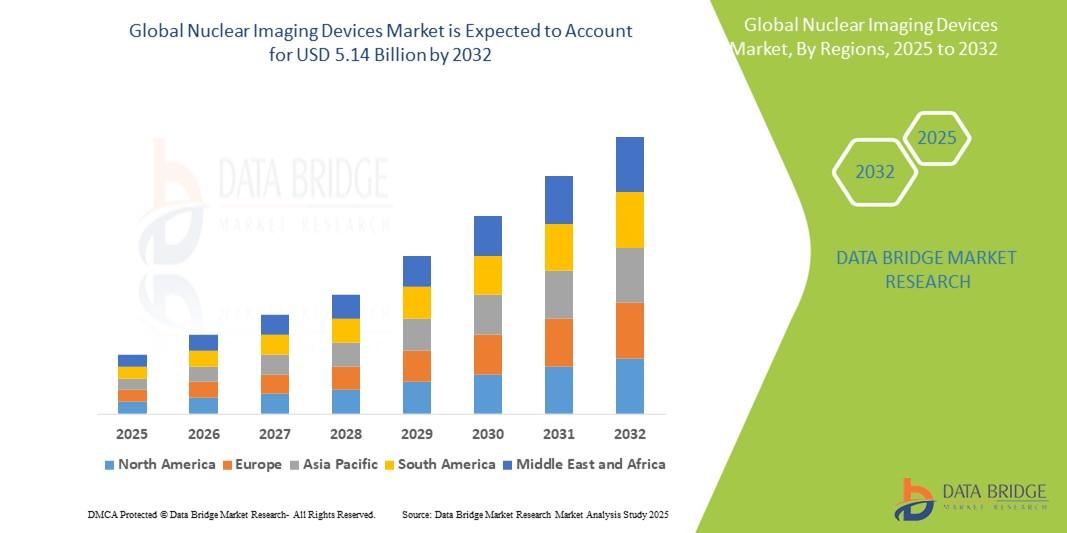
According to the latest report published by Data Bridge Market Research, the Nuclear Imaging Devices Market size is projected to grow from USD 3.25 Billion in 2024 to USD 5.14 Billion by 2032, exhibiting a CAGR of 5.90% during the forecast period 2025 - 2032.
Nuclear Imaging Devices Market report, businesses can acquire details about market drivers and market restraints which help them to guess about reducing or growing the production of particular product. It also arranges for top to bottom examination of the market for estimating income, return on investment (ROI) and developing business strategies. This Nuclear Imaging Devices Market research report comprises of the most significant market insights that takes business to the highest level of growth and success. Various trustworthy sources such as journals, websites, and annual reports of the companies, white papers, and mergers have been used for assembling data and information mentioned in this report.
Stay informed with our latest keyword market research covering strategies, innovations, and forecasts. Download full report: https://www.databridgemarketresearch.com/reports/global-nuclear-imaging-devices-market
Nuclear Imaging Devices Market Segmentation and Market Companies
Segments
- By Product Type:
- SPECT Systems
- PET Systems
- Planar Scintigraphy
- Hybrid Imaging (SPECT/CT, PET/CT, SPECT/MR, PET/MR)
- By Application:
- Oncology
- Cardiology
- Neurology
- Others
- By End-User:
- Hospitals
- Imaging Centers
- Academic and Research Centers
- By Geography:
- North America
- Europe
- Asia-Pacific
- South America
- Middle East and Africa
The global nuclear imaging devices market is segmented based on product type, application, end-user, and geography. In terms of product type, the market is categorized into SPECT systems, PET systems, planar scintigraphy, and hybrid imaging such as SPECT/CT, PET/CT, SPECT/MR, and PET/MR. On the basis of application, the market is divided into oncology, cardiology, neurology, and others. When considering the end-user, the market is segmented into hospitals, imaging centers, and academic and research centers. Geographically, the market is analyzed across North America, Europe, Asia-Pacific, South America, and the Middle East and Africa regions.
Market Players
- Siemens Healthineers
- GE Healthcare
- Koninklijke Philips N.V.
- Canon Inc.
- DDD-Diagnostic A/S
- Mediso Ltd.
- SurgicEye GmbH
- CMR Naviscan Corporation
- Toshiba Corporation
- Digirad Corporation
Key market players in the global nuclear imaging devices market include Siemens Healthineers, GE Healthcare, Koninklijke Philips N.V., Canon Inc., DDD-Diagnostic A/S, Mediso Ltd., SurgicEye GmbH, CMR Naviscan Corporation, Toshiba Corporation, and Digirad Corporation. These players are focusing on technological advancements, strategic collaborations, and mergers and acquisitions to strengthen their market presence and expand their product portfolio in the competitive landscape of the nuclear imaging devices market.
The global nuclear imaging devices market is witnessing significant growth driven by various factors such as the increasing prevalence of chronic diseases like cancer and cardiovascular disorders, growing geriatric population, and the rising demand for early and accurate diagnosis. With advancements in technology and the development of hybrid imaging systems, the market is poised for further expansion. Hybrid imaging systems like SPECT/CT, PET/CT, SPECT/MR, and PET/MR offer superior imaging capabilities, enabling healthcare providers to obtain detailed anatomical and functional information in a single scan. This convergence of molecular imaging with anatomical imaging is revolutionizing diagnostic practices and enhancing patient outcomes across various medical specialties.
In terms of application, oncology remains a dominant segment in the nuclear imaging devices market due to the increasing incidence of cancer globally. Nuclear imaging plays a crucial role in cancer diagnosis, staging, treatment planning, and monitoring treatment response. Cardiology is another key application segment, benefiting from nuclear imaging techniques in the evaluation of cardiac function, myocardial perfusion, and viability assessment. As cardiovascular diseases continue to be a major cause of mortality worldwide, the demand for advanced imaging modalities in cardiology is expected to rise.
The market is witnessing a shift towards decentralized healthcare delivery, leading to the proliferation of imaging centers and outpatient facilities. Hospitals remain the largest end-users of nuclear imaging devices, owing to the availability of advanced infrastructure and skilled healthcare professionals. Imaging centers are gaining traction as they offer convenient access to imaging services and cater to the growing demand for outpatient diagnostic procedures. Academic and research centers play a crucial role in driving technological innovation and clinical research in the field of nuclear imaging, fostering collaborations between industry players and academia.
On a geographical basis, North America and Europe hold significant market shares in the global nuclear imaging devices market, attributed to well-established healthcare infrastructure, increasing healthcare expenditure, and a high prevalence of chronic diseases. Asia-Pacific is emerging as a lucrative market for nuclear imaging devices, driven by the growing healthcare awareness, improving healthcare infrastructure, and increasing investments in medical imaging technologies. South America and the Middle East and Africa regions are also witnessing growth opportunities in the nuclear imaging devices market, supported by government initiatives to improve healthcare access and quality.
In conclusion, the global nuclear imaging devices market is poised for steady growth, driven by technological advancements, increasing disease burden, and the expanding applications of nuclear imaging in clinical practice. Key market players are actively involved in product development and strategic collaborations to maintain their competitive edge in the dynamic market landscape. As healthcare providers continue to prioritize early and accurate diagnosis, nuclear imaging devices are set to play a pivotal role in transforming patient care and improving health outcomes globally.The global nuclear imaging devices market is experiencing a paradigm shift driven by technological advancements, shifting healthcare trends, and increasing disease burden worldwide. One of the significant factors propelling market growth is the rising prevalence of chronic diseases, particularly cancer and cardiovascular disorders, necessitating advanced diagnostic tools for early detection and accurate assessment. The convergence of molecular imaging with anatomical imaging in hybrid imaging systems such as SPECT/CT, PET/CT, SPECT/MR, and PET/MR is revolutionizing diagnostic practices by providing detailed functional and anatomical information in a single scan. These sophisticated imaging systems are gaining traction among healthcare providers for their superior imaging capabilities and potential to enhance patient outcomes in various medical specialties.
Oncology remains a pivotal application segment in the nuclear imaging devices market due to the escalating cancer incidence globally. Nuclear imaging techniques play a vital role in cancer diagnosis, staging, treatment planning, and treatment response monitoring, driving the demand for advanced imaging solutions in oncology. Similarly, cardiology emerges as a crucial segment benefiting from nuclear imaging technologies for evaluating cardiac function, myocardial perfusion, and viability assessment, particularly in the context of rising cardiovascular disease burden worldwide.
As healthcare delivery becomes increasingly decentralized, imaging centers and outpatient facilities are witnessing a surge in demand, offering convenient access to diagnostic services for patients. While hospitals continue to dominate the end-user landscape of nuclear imaging devices due to advanced infrastructure and skilled professionals, imaging centers are gaining popularity for their accessibility and focus on outpatient diagnostic procedures. Academic and research centers also play a pivotal role in advancing technology and driving research collaborations within the nuclear imaging domain, contributing to innovation and knowledge exchange in the field.
Geographically, North America and Europe hold substantial market shares in the global nuclear imaging devices market, driven by robust healthcare infrastructure, high healthcare spending, and a significant burden of chronic diseases. In contrast, the Asia-Pacific region presents lucrative opportunities for market expansion, fueled by increasing healthcare awareness, improving healthcare infrastructure, and rising investments in medical imaging technologies. South America and the Middle East and Africa regions are also witnessing growth prospects, supported by governmental initiatives aimed at enhancing healthcare access and quality standards. Overall, the global nuclear imaging devices market is poised for continuous growth, with key market players focusing on innovation, collaborations, and strategic partnerships to stay competitive in the rapidly evolving healthcare landscape.
Frequently Asked Questions About This Report
What does the value chain for the Nuclear Imaging Devices Market look like?
How are tiered supplier networks managed in the Nuclear Imaging Devices Market industry?
How are companies diversifying their supply chains to drive growth?
What is the role of third-party logistics (3PL) in the Nuclear Imaging Devices Market?
What is the total addressable market (TAM) for Nuclear Imaging Devices Market solutions?
What is the projected valuation for the [Specific Segment] in the Nuclear Imaging Devices Market by 2033?
What is the projected market size of the Nuclear Imaging Devices Market in 2025?
What is the growth of the Nuclear Imaging Devices Market in Tier 2 cities in China?
Which raw material segment currently dominates the Nuclear Imaging Devices Market?
How are key players expanding their regional footprint in the Nuclear Imaging Devices Market?
How is the Nuclear Imaging Devices Market evolving in terms of packaging and delivery?
How is the Digital Twin technology impacting the Nuclear Imaging Devices Market value chain?
How is the supply chain of the Nuclear Imaging Devices Market being optimized?
Browse More Reports:
Global Mandelic Acid Market
Global Medical Electronics Market
Global Medical Imaging Displays and Post-Processing Software Market
Global Medical Injection Moulding Market
Global Medical X-Ray 3D-Radiography Equipment Market
Global Metal and Ceramic Injection Molding Market
Global Metastatic Cancer Drug Market
Global Mitotic Inhibitors Market
Global Mobile Tracking Solutions Market
Global Moisture Barrier Bags Market
Global mRNA Drug Substance and API Market
Global Muconic Acid Market
Global Needle-Free Diabetes Care Market
Global Next-Generation Antibody-Drug Conjugate (ADC) Therapies Market
Global Noise, Vibration and Harshness (NVH) Testing Market
Contact Us:
Data Bridge Market Research
US: +1 614 591 3140
UK: +44 845 154 9652
APAC : +653 1251 979
Email:- [email protected]
- Monuments historiques
- Restaurant Traditionnel
- Éducation
- Mode
- Formation
- Information
- Restaurant
- culture
- تسويق
- Tourisme
- سياحة
- تنمية
- Découverte
- Art
- Causes
- Crafts
- Dance
- Drinks
- Film
- Fitness
- Food
- Jeux
- Gardening
- Health
- Domicile
- Literature
- Music
- Networking
- Autre
- Party
- Religion
- Shopping
- Sports
- Theater
- Wellness
 French
 English
 Arabic
 Spanish
 Portuguese
 Deutsch
 Turkish
 Dutch
 Italiano
 Russian
 Romaian
 Portuguese (Brazil)
 Greek
