


Intraocular Lens (IOL) Market Size, Share, Growth and Industry Forecast - 2033
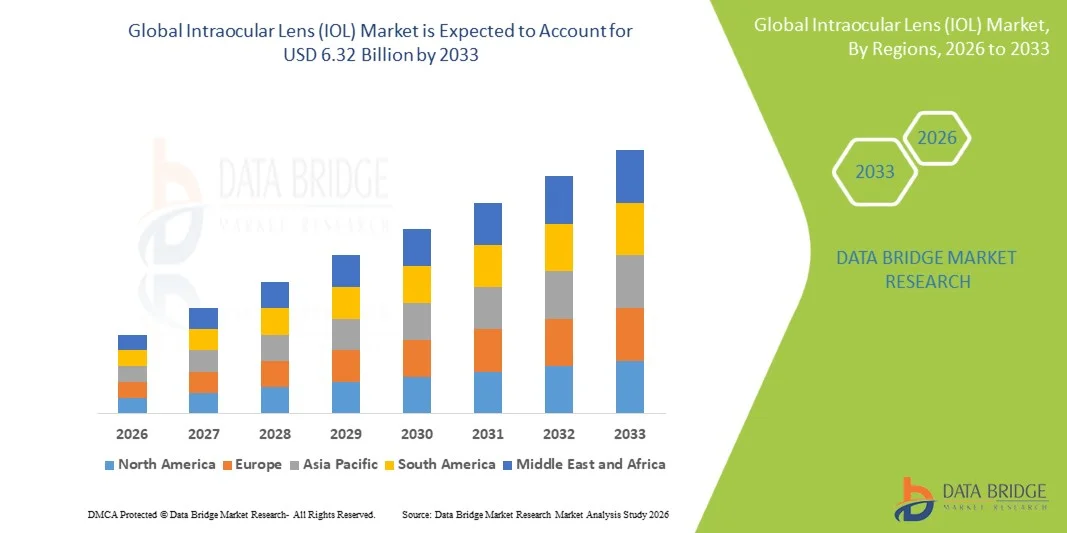
According to the latest report published by Data Bridge Market Research, the Intraocular Lens (IOL) Market size is projected to reach USD 6.32 Billion by 2033, exhibiting a CAGR of 5.00% during the forecast period 2026 - 2033.
To impart a supreme quality to this persuasive Intraocular Lens (IOL) Market report, unswerving efforts of enthusiastic, dynamic and skilled researchers and analysts have been utilized. Evaluations about the CAGR value variations for specific forecast period, market drivers, market restraints, and competitive strategies are measured in this Intraocular Lens (IOL) Market report. Two of the most widely used techniques namely SWOT analysis and Porter's Five Forces Analysis have been applied in the whole report while preparing it. This market research report provides wide-ranging analysis of the market structure along with evaluations of the various segments and sub-segments of the market.
Stay informed with our latest keyword market research covering strategies, innovations, and forecasts. Download full report: https://www.databridgemarketresearch.com/reports/global-intraocular-lens-iol-market
Intraocular Lens (IOL) Market Segmentation and Market Companies
Segments
- By Type:
- Monofocal IOLs
- Multifocal IOLs
- Toric IOLs
- Accommodating IOLs
- Others
- By Material:
- Polymethyl Methacrylate (PMMA)
- Silicone
- Hydrophobic Acrylic
- Hydrophilic Acrylic
- By End-User:
- Hospitals
- Ophthalmology Clinics
- Ambulatory Surgical Centers
- Others
- By Geography:
- North America
- Europe
- Asia-Pacific
- South America
- Middle East and Africa
Intraocular lenses (IOLs) are essential for cataract surgery and vision correction. The global IOL market is segmented based on type, material, end-user, and geography. In terms of type, the market is categorized into monofocal IOLs, multifocal IOLs, toric IOLs, accommodating IOLs, and others. Monofocal IOLs are the most commonly used lenses providing clear vision at a single focal point, while multifocal IOLs offer vision at different distances. Toric IOLs correct astigmatism, and accommodating IOLs mimic the natural focusing ability of the eye. By material, IOLs are made from polymethyl methacrylate (PMMA), silicone, hydrophobic acrylic, or hydrophilic acrylic. Different materials offer various benefits such as flexibility, durability, and biocompatibility. End-users of IOLs include hospitals, ophthalmology clinics, ambulatory surgical centers, and others. Geographically, the market is analyzed across North America, Europe, Asia-Pacific, South America, and the Middle East and Africa.
Market Players
- Alcon, Inc.
- Johnson & Johnson Vision
- Bausch & Lomb
- Carl Zeiss Meditec AG
- Hoya Corporation
- STAAR Surgical Company
- Rayner Intraocular Lenses Limited
- Eyekon Medical, Inc.
- PhysIOL
- Biotech Vision Care
- Oculentis
- Lenstec, Inc.
Several key players dominate the global intraocular lens market. Alcon, Inc., a division of Novartis, is a leading provider of eye care products, including a wide range of IOLs. Johnson & Johnson Vision, under the ACUVUE brand, offers innovative solutions for vision correction. Bausch & Lomb is renowned for its comprehensive portfolio of eye health products, including premium IOLs. Carl Zeiss Meditec AG specializes in cutting-edge medical technology, including precision optics for cataract surgery. Hoya Corporation is known for its advanced optical solutions, including premium IOLs for improved visual outcomes. STAAR Surgical Company focuses on refractive and cataract surgery products, including implantable collamer lenses. Other notable market players include Rayner Intraocular Lenses Limited, Eyekon Medical, Inc., PhysIOL, Biotech Vision Care, Oculentis, and Lenstec, Inc. These companies drive innovation and competition in the global IOL market, catering to the diverse needs of patients and healthcare providers.
The global intraocular lens (IOL) market is witnessing significant growth driven by several key factors. One of the primary drivers is the increasing prevalence of cataract cases worldwide, particularly among the aging population. As people age, the risk of developing cataracts rises, leading to a higher demand for cataract surgery and IOL implantation. Additionally, advancements in surgical techniques and technology have enhanced the success rates of cataract surgeries, further fueling the adoption of IOLs. The shift towards minimally invasive procedures and the development of premium IOLs with features like UV protection, blue light filtering, and extended depth of focus have also contributed to market expansion.
Moreover, the rising prevalence of refractive errors such as myopia, hyperopia, and astigmatism has led to an increasing number of patients opting for vision correction procedures involving the implantation of IOLs. This trend is expected to drive the demand for premium IOLs like multifocal and toric lenses, which offer enhanced visual outcomes and reduced dependency on corrective eyewear. Market players are focusing on developing innovative IOLs that not only address vision issues but also provide added benefits such as reducing glare and halos, improving contrast sensitivity, and optimizing overall visual quality.
Another crucial factor influencing the IOL market is the expanding geriatric population globally. With the elderly demographic being more prone to age-related eye conditions, including cataracts, the demand for IOLs is projected to surge in the coming years. Furthermore, increasing healthcare expenditure, improving healthcare infrastructure, and growing awareness about the benefits of cataract surgery and IOL implantation are contributing to market growth. Market players are actively engaged in strategic activities like mergers, acquisitions, product launches, and collaborations to strengthen their market presence and expand their product portfolios.
In terms of geographical analysis, North America and Europe presently hold significant market shares due to the well-established healthcare infrastructure, high adoption rates of advanced technologies, and increasing focus on ophthalmic health. However, the Asia-Pacific region is emerging as a lucrative market for IOLs, driven by the growing aging population, improving access to healthcare services, and rising disposable incomes. South America and the Middle East and Africa regions are also witnessing steady growth in the IOL market, propelled by evolving healthcare systems and a greater emphasis on eye care.
In conclusion, the global intraocular lens market is poised for robust growth in the coming years, supported by factors such as the increasing prevalence of cataracts and refractive errors, technological advancements in IOL design, expanding geriatric population, and growing awareness about eye health. Market players continue to innovate and collaborate to meet the evolving needs of patients and healthcare providers, ensuring a competitive landscape and a wide range of options for vision correction and cataract surgery.The intraocular lens (IOL) market is a dynamic sector witnessing significant growth propelled by various key factors. One of the primary drivers is the aging population worldwide, leading to an increased prevalence of cataracts and the subsequent demand for cataract surgeries and IOL implantation. As advancements in surgical techniques and technology continue to improve, the success rates of these procedures rise, further boosting the adoption of IOLs. Moreover, the trend towards minimally invasive surgeries and the development of premium IOLs with advanced features like UV protection, blue light filtering, and extended depth of focus are contributing to market expansion by catering to patients' growing expectations for enhanced visual outcomes.
Furthermore, the escalating prevalence of refractive errors such as myopia, hyperopia, and astigmatism is driving more individuals towards vision correction procedures involving IOL implantation. This shift is expected to increase the demand for premium IOLs like multifocal and toric lenses, offering superior visual results and reducing the reliance on corrective eyewear. Market players are increasingly focusing on innovation to develop IOLs that not only address vision impairments but also provide additional benefits such as reducing glare and halos, enhancing contrast sensitivity, and optimizing overall visual quality for patients.
Another crucial factor impacting the IOL market is the expanding geriatric population globally, who are more susceptible to age-related eye conditions such as cataracts. This demographic trend is projected to drive a surge in the demand for IOLs in the coming years. Additionally, factors such as increasing healthcare expenditure, improving healthcare infrastructure, and rising awareness regarding the advantages of cataract surgery and IOL implantation are contributing to market growth. Market players are actively involved in strategic initiatives like mergers, acquisitions, product launches, and collaborations to strengthen their market position and diversify their product offerings to meet the evolving needs of patients and healthcare providers.
In conclusion, the global intraocular lens market is on a trajectory of strong growth driven by factors like the rising prevalence of cataracts and refractive errors, technological innovations in IOL design, expanding geriatric population, and increasing awareness regarding eye health. Market participants are committed to creating innovative solutions and partnerships to adapt to changing market dynamics, ensuring a competitive landscape that offers a wide array of options for vision correction and cataract surgery. The market's growth trajectory is likely to continue upwards, presenting opportunities for further advancements and developments in the field of intraocular lenses.
Frequently Asked Questions About This Report
What is the impact of Regional on the Intraocular Lens (IOL) Market?
What is the Consumer Sentiment Index for the Intraocular Lens (IOL) Market?
What is the market valuation of the Intraocular Lens (IOL) Market industry in China and India?
What is the impact of blockchain technology on Intraocular Lens (IOL) Market transparency?
What is the Resilience Score of the global Intraocular Lens (IOL) Market industry?
Why is the Asia-Pacific region expected to be the fastest-growing Intraocular Lens (IOL) Market?
What will be the market value for Hardware offerings in the Intraocular Lens (IOL) Market by 2033?
How is the Buy Local trend impacting the Intraocular Lens (IOL) Market in Australia?
How do Institutional buyers influence the Intraocular Lens (IOL) Market pricing?
What is the projected market valuation for the Intraocular Lens (IOL) Market by 2033?
How is digitalization transforming the Intraocular Lens (IOL) Market supply chain?
What are the key product innovations launched in the Intraocular Lens (IOL) Market in 2025?
Browse More Reports:
Global Arthropod-Borne Viral Infections Testing Market
Global Cavitated Film Market
Global Photoacoustic Tomography Market
Global Polypropylene Homopolymer Market
Global Restylane Injectable Fillers Market
Global Swine Feed Phosphates Market
Global Bio preservation Market
Global Sepsis Treatment Market
Global Healthcare Cloud Computing Market
Global Hybrid Imaging Market
Global Baby Care Packaging Market
Global Epigallocatechin Gallate Market
Global Systemic Lupus Erythematosus Market
Global Specialty Polystyrene Resin Market
Global Image-Guided Biopsy Market
Contact Us:
Data Bridge Market Research
US: +1 315 716 2465
UK: +44 121 387 1739
APAC : +656 2026 606
Email:- [email protected]
 English
 Arabic
 French
 Spanish
 Portuguese
 Deutsch
 Turkish
 Dutch
 Italiano
 Russian
 Romaian
 Portuguese (Brazil)
 Greek
