


Artificial Intelligence in Aviation Market Trends, Size and Global Industry Outlook - 2032
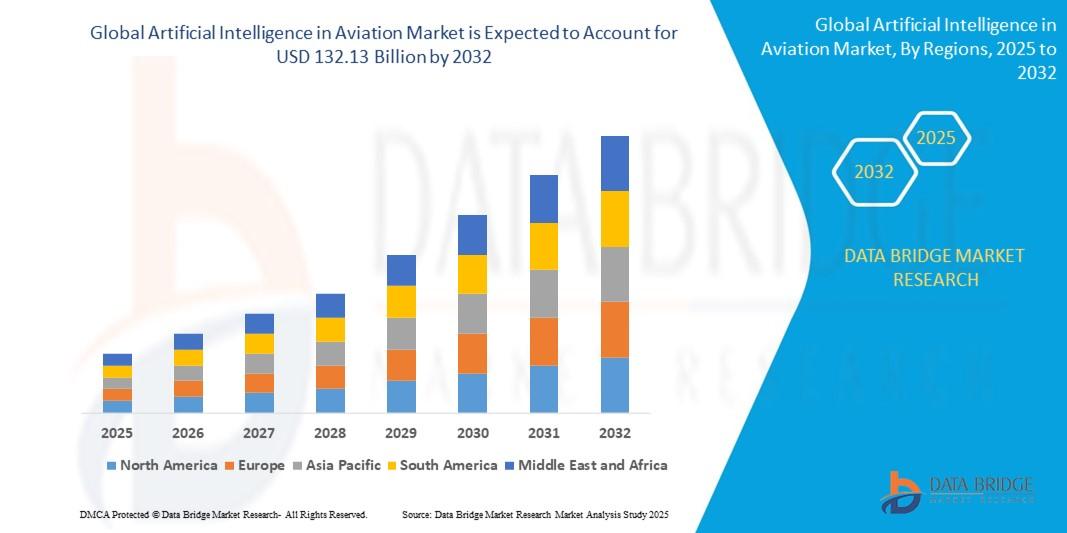
According to the latest report published by Data Bridge Market Research, the Artificial Intelligence in Aviation Market size is projected to reach USD 132.13 Billion by 2032, exhibiting a CAGR of 46.20% during the forecast period 2025 - 2032.
Artificial Intelligence in Aviation Market is the finest market research report which is the result of proficient team and their potential capabilities. A strong research methodology consists of data models that include Market Overview and Guide, Vendor Positioning Grid, Market Time Line Analysis, Company Positioning Grid, Company Market Share Analysis, Standards of Measurement, Top to Bottom Analysis and Vendor Share Analysis. The identity of respondents is kept secret and no promotional approach is made to them while analysing the market data included in this document. The quality and transparency maintained in this Artificial Intelligence in Aviation Market report makes DBMR team gain the trust and reliance of the member companies and customers.
Stay informed with our latest keyword market research covering strategies, innovations, and forecasts. Download full report: https://www.databridgemarketresearch.com/reports/global-artificial-intelligence-in-aviation-market
Artificial Intelligence in Aviation Market Segmentation and Market Companies
Segments
- Technology: The AI in aviation market can be segmented based on technology into Machine Learning, Natural Language Processing (NLP), Context Awareness Computing, and Computer Vision.
- Application: The market can also be segmented by application into Virtual Assistants, Smart Maintenance, Manufacturing, Training, and Flight Operations.
- End User: Segmentation by end user includes segments such as Airlines, Airports, Maintenance, Repair, and Overhaul (MRO) Service Providers, and Air Traffic Management.
With the rapid advancements in technology, the implementation of artificial intelligence in the aviation sector has seen a significant rise. The market segmentation based on technology includes Machine Learning, which is extensively used to facilitate automation and predictive analysis in various aviation operations. Natural Language Processing (NLP) is another crucial segment, enhancing communication between machines and humans, improving customer service and operational efficiency. Context Awareness Computing and Computer Vision are also key segments, enabling real-time data analysis and enhancing safety measures in aviation processes. The application segment plays a vital role in AI adoption in aviation, with virtual assistants, smart maintenance, and manufacturing driving operational excellence. Flight operations and training are also key areas where AI technology is making a substantial impact. Furthermore, the end-user segmentation showcases how airlines, airports, and MRO service providers are leveraging AI solutions to streamline their operations and enhance customer experience.
Market Players
- IBM Corporation: IBM offers AI solutions tailored for the aviation sector, providing advanced analytics, predictive maintenance, and operational efficiency tools.
- Intel Corporation: Intel provides AI-powered chips and processors used in aviation applications, supporting real-time data processing and analytics.
- Microsoft Corporation: Microsoft offers cloud-based AI solutions for the aviation industry, enabling data management, collaboration, and decision-making processes.
- Airbus SE: Airbus utilizes AI technology for aircraft manufacturing, maintenance, and operational optimization, enhancing safety and performance.
- Boeing Company: Boeing integrates AI solutions for flight simulations, predictive maintenance, and manufacturing processes, improving overall efficiency.
The global artificial intelligence in aviation market is witnessing robust growth, driven by advancements in technology and increasing demand for operational efficiency and safety measures in the aviation sector. Key market players such as IBM, Intel, Microsoft, Airbus, and Boeing are at the forefront of providing innovative AI solutions tailored for the aviation industry, catering to the diverse needs of airlines, airports, and MRO service providers. With continuous technological developments and increasing investments, the AI in aviation market is poised for substantial growth in the coming years.
The global artificial intelligence in aviation market is undergoing a transformative phase, propelled by the convergence of advanced technologies and the rising need for efficiency and safety in the aviation industry. Beyond the existing segments of technology, application, and end-users, there are emerging trends and factors shaping the market landscape. One notable trend is the increasing focus on autonomous systems, including autonomous drones and unmanned aerial vehicles (UAVs). These systems are equipped with AI algorithms for navigation, surveillance, and other critical tasks, enhancing operational capabilities and enabling new applications in agriculture, surveillance, and delivery services.
Another significant trend is the integration of AI-powered predictive maintenance solutions, which enable airlines and MRO service providers to anticipate potential equipment failures and schedule maintenance proactively, reducing downtime and operational costs. Moreover, the implementation of AI in air traffic management is enhancing airspace utilization, optimizing flight routes, and improving overall safety and efficiency in the global aviation network. This trend is driven by the need to accommodate the increasing air traffic volume and ensure seamless operations in congested airspace.
Furthermore, the adoption of AI solutions for enhancing passenger experience is gaining traction in the aviation industry. Virtual assistants, powered by AI technology, are being deployed in airport terminals and onboard aircraft to provide personalized services, answer passenger queries, and streamline the travel experience. Additionally, AI-enabled security systems are being integrated into airport infrastructure to enhance security screening processes, detect potential threats, and ensure passenger safety.
In terms of market dynamics, the increasing collaborations and partnerships between technology providers, aviation stakeholders, and government agencies are fostering innovation and driving the adoption of AI solutions in the aviation sector. These collaborations facilitate knowledge sharing, research and development initiatives, and the implementation of pilot projects to demonstrate the capabilities of AI in improving operational efficiency and safety in aviation operations. Moreover, regulatory support and initiatives promoting the use of AI in aviation, such as the integration of AI-powered systems in air traffic control and aerospace manufacturing, are further driving market growth and innovation.
Overall, the global artificial intelligence in aviation market is poised for significant expansion, supported by technological advancements, increasing investment in AI research and development, and the growing recognition of AI's potential to revolutionize the aviation industry. As market players continue to innovate and collaborate, the adoption of AI solutions across various segments of the aviation industry is expected to accelerate, leading to enhanced operational efficiency, safety, and passenger experience.The global artificial intelligence in aviation market is a rapidly evolving landscape, driven by the convergence of cutting-edge technologies and the increasing demand for enhanced operational efficiency, safety, and passenger experience in the aviation industry. One of the key trends shaping this market is the rise of autonomous systems, such as drones and UAVs, which are powered by AI algorithms for navigation and surveillance, expanding the scope of applications in agriculture, surveillance, and delivery services. These systems offer operational capabilities that were previously unattainable, leading to increased efficiency and innovation in the aviation sector.
Another notable trend is the integration of AI-powered predictive maintenance solutions, enabling proactive maintenance scheduling and minimizing downtime for airlines and MRO service providers. By leveraging AI for predictive maintenance, organizations can anticipate equipment failures and optimize maintenance processes, resulting in cost savings and improved operational performance. Furthermore, the adoption of AI in air traffic management is revolutionizing airspace utilization, flight route optimization, and overall safety within the global aviation network. This is crucial in managing the escalating air traffic volume and ensuring smooth operations in congested airspace.
Enhancing passenger experience is emerging as a key focus area in the aviation industry, with the deployment of AI-driven virtual assistants and security systems. Virtual assistants are being utilized to deliver personalized services, answer queries, and streamline the travel experience for passengers in airports and onboard aircraft. AI-enabled security systems play a pivotal role in enhancing security screening processes, threat detection, and ensuring passenger safety across airport facilities. These initiatives underscore the industry's commitment to leveraging AI technology to create a seamless and secure travel environment for passengers.
The market dynamics of the artificial intelligence in aviation sector are characterized by increasing collaborations and partnerships between technology providers, aviation stakeholders, and government entities. These partnerships are driving innovation, knowledge sharing, and research and development efforts to advance the application of AI solutions in aviation operations. Regulatory support and initiatives promoting the adoption of AI in air traffic control and aerospace manufacturing are further catalyzing market growth and fostering a conducive environment for innovation in the industry.
In conclusion, the global artificial intelligence in aviation market is poised for substantial expansion, driven by technological advancements, robust investment in AI research and development, and a growing recognition of AI's transformative potential in aviation. As market players continue to innovate and collaborate, the widespread adoption of AI solutions across various segments of the aviation industry is expected to propel operational efficiency, safety, and passenger experience to new heights.
Frequently Asked Questions About This Report
What are the opportunities for Artificial Intelligence in Aviation Market in the Silver Economy (elderly care)?
What is the valuation of Artificial Intelligence in Aviation Market in the Sports & Fitness market?
How are top players using M&A to secure their value chain?
What is the market valuation of the Artificial Intelligence in Aviation Market industry in China and India?
How is Lean Manufacturing impacting the Artificial Intelligence in Aviation Market?
What is the projected valuation for the [Specific Segment] in the Artificial Intelligence in Aviation Market by 2033?
What are the primary offensive strategies in the Artificial Intelligence in Aviation Market?
What is the customer acquisition cost (CAC) in the Artificial Intelligence in Aviation Market industry?
How are companies building Antifragility in the Artificial Intelligence in Aviation Market?
How will the Artificial Intelligence in Aviation Market contribute to the global [Goal, e.g., Net Zero]?
What is the expected CAGR for the Artificial Intelligence in Aviation Market during the forecast period?
How is the supply chain of the Artificial Intelligence in Aviation Market being optimized?
What is the projected growth of the Artificial Intelligence in Aviation Market in North America?
What are the procurement strategies in the Artificial Intelligence in Aviation Market industry?
Browse More Reports:
Global Do-It-Yourself (DIY) Tools Market
Global Bouillon Market
Global Culinary Tourism Market
Global Digital Out of Home (OOH) Advertising Market
Global Luxury Cosmetics Market
Global Hemp Clothing Market
Global Laser Plastic Welding Market
Global Frozen Ready Meals Market
Global Data Center Uninterruptable Power Supply (UPS) Market
Global Lemon Juice Concentrate Market
Global Iced Tea Market
Global Abrasives Market
Global Pre Owned Luxury Watches Market
Global Superfood Market
Global Sourdough Market
 Portuguese
 English
 Arabic
 French
 Spanish
 Deutsch
 Turkish
 Dutch
 Italiano
 Russian
 Romaian
 Portuguese (Brazil)
 Greek
