


Smart Grid Market Growth Drivers and Industry Analysis - 2032
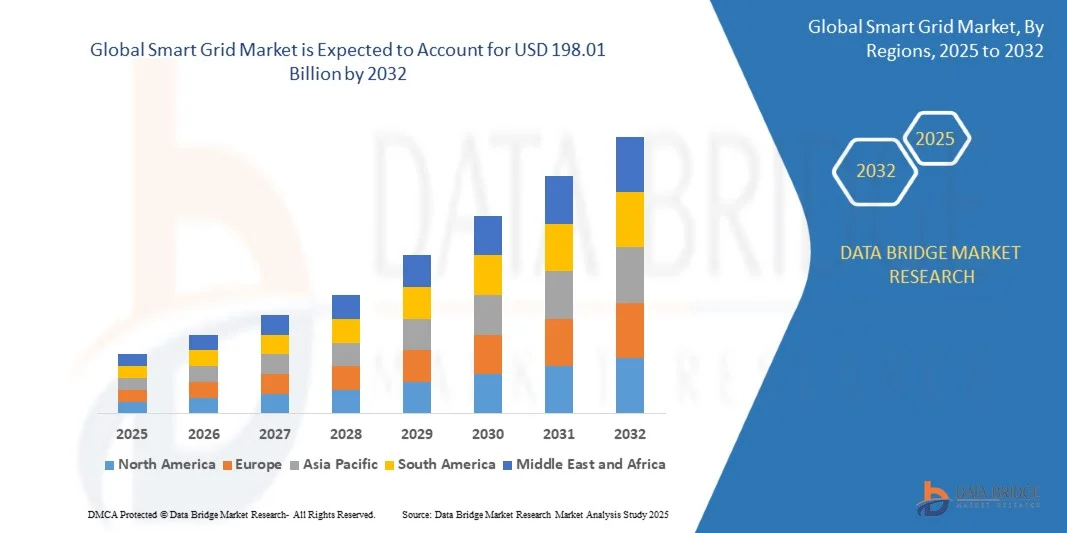
According to the latest report published by Data Bridge Market Research, the Smart Grid Market size is projected to reach USD 198.01 Billion by 2032, exhibiting a CAGR of 18.72% during the forecast period 2025 - 2032.
The reliable Smart Grid Market report is generated by considering the market type, volume of the organization, accessibility on-premises and the end-users’ organization type, and availability at global level in areas such as North America, South America, Europe, Asia-Pacific, Middle East and Africa. In addition, Smart Grid Marketing research report helps in planning by providing accurate and state-of-the-art information about the consumer’s demands, their buying preferences, attitudes and their changing tastes about the specific product. It facilitates in adjusting the production depending on the conditions of demand which avoids wastage of goods. The Smart Grid Market document is highly useful to uncover the general market conditions and tendencies.
Stay informed with our latest keyword market research covering strategies, innovations, and forecasts. Download full report: https://www.databridgemarketresearch.com/reports/global-smart-grid-market
Smart Grid Market Segmentation and Market Companies
Segments
- By Component:
- Software
- Hardware
- Services
- By End-User:
- Industrial
- Commercial
- Residential
- By Geography:
- North America
- Europe
- Asia-Pacific
- South America
- Middle East and Africa
The global smart grid market is segmented based on components, end-users, and geography. The market is categorized into components such as software, hardware, and services. The software segment includes various solutions focused on managing and optimizing grid operations, while hardware consists of physical devices like smart meters, sensors, and communication networks. Services involve consulting, maintenance, and managed services to support smart grid systems. In terms of end-users, the market caters to industries, commercial establishments, and residential sectors. Industries deploy smart grid technologies to enhance operational efficiency and reduce costs, while commercial and residential users benefit from improved energy management and sustainability practices. Geographically, the market is analyzed across regions like North America, Europe, Asia-Pacific, South America, and the Middle East and Africa, each presenting unique opportunities and challenges for smart grid adoption.
Market Players
- General Electric
- Siemens AG
- ABB
- Schneider Electric
- Cisco Systems, Inc.
- IBM Corporation
- Honeywell International Inc.
- Eaton
- Itron Inc.
- Oracle
Key market players in the global smart grid industry include renowned organizations like General Electric, Siemens AG, ABB, Schneider Electric, Cisco Systems, Inc., IBM Corporation, Honeywell International Inc., Eaton, Itron Inc., and Oracle. These companies are at the forefront of developing innovative smart grid solutions, ranging from advanced metering infrastructure to grid optimization software. Their products and services cater to a diverse range of customers, enabling efficient energy management, grid modernization, and sustainability initiatives across various sectors. With a strong focus on research and development, strategic partnerships, and technological advancements, these market players play a crucial role in driving the evolution of smart grids worldwide.
The global smart grid market is witnessing a significant transformation driven by advancing technologies, increasing demand for efficient energy solutions, and growing environmental concerns. One emerging trend in the market is the integration of Internet of Things (IoT) and artificial intelligence (AI) to enhance grid automation, predictive maintenance, and decentralized energy management. IoT devices such as smart meters and sensors enable real-time data collection and monitoring, while AI algorithms analyze this data to optimize grid performance and enable proactive decision-making. This convergence of IoT and AI is revolutionizing grid operations, improving reliability, and enabling utilities to meet evolving energy demands effectively.
Another key development in the smart grid market is the focus on cybersecurity solutions to safeguard critical energy infrastructure from cyber threats and ransomware attacks. As smart grid systems become more interconnected and data-driven, the need for robust cybersecurity measures has become paramount. Market players are investing in cutting-edge cybersecurity technologies, such as blockchain, encryption, and intrusion detection systems, to protect grid assets, data integrity, and customer privacy. Ensuring a secure and resilient smart grid infrastructure is essential for maintaining grid stability, preventing disruptions, and building trust among stakeholders in the energy ecosystem.
Moreover, the shift towards renewable energy integration and grid decarbonization is shaping the future of the smart grid market. With the increasing deployment of solar, wind, and other clean energy sources, smart grid solutions play a crucial role in managing grid congestion, balancing supply and demand, and optimizing energy storage. By leveraging advanced analytics, predictive modeling, and demand response programs, utilities can maximize renewable energy utilization, reduce carbon emissions, and achieve sustainable energy goals. The transition towards a low-carbon grid requires innovative smart grid technologies that enable seamless integration of renewables, promote energy efficiency, and support grid stability in a decentralized energy landscape.
Furthermore, the emergence of smart cities and digitalization initiatives is driving the adoption of smart grid solutions in urban environments. Smart grids play a vital role in enabling smart city infrastructure, optimizing energy consumption, and supporting electric mobility initiatives. With the deployment of smart meters, smart lighting systems, and grid-connected electric vehicles, cities can enhance energy efficiency, reduce carbon footprint, and improve overall quality of life for residents. The integration of smart grid technologies with smart city projects creates synergies in data management, energy optimization, and sustainable urban development, paving the way for a more connected and sustainable future.
In conclusion, the global smart grid market is undergoing rapid evolution, driven by technological advancements, regulatory mandates, and changing consumer expectations. The convergence of IoT, AI, cybersecurity, renewable energy, and smart city initiatives is reshaping the energy landscape and creating new opportunities for market players to innovate and deliver value-added solutions. As the smart grid market continues to expand globally, collaboration among industry stakeholders, policymakers, and technology providers will be essential to accelerate the transition towards a more resilient, efficient, and sustainable energy infrastructure.The global smart grid market is currently experiencing a notable transformation propelled by technological advancements, escalating demand for efficient energy solutions, and heightened environmental concerns. An emerging trend within the market is the integration of Internet of Things (IoT) and artificial intelligence (AI) technologies to bolster grid automation, predictive maintenance, and decentralized energy management practices. This amalgamation allows for real-time data collection and monitoring facilitated by IoT devices like smart meters and sensors, with AI algorithms analyzing this data to optimize grid performance and support informed decision-making processes. This innovation in IoT and AI convergence is revolutionizing grid operations, improving reliability, and enabling utilities to adeptly address evolving energy requirements.
Additionally, a critical development in the smart grid realm is the intensified focus on cybersecurity solutions to fortify critical energy infrastructure against cyber threats and ransomware attacks. As smart grid systems increasingly interconnect and rely on data-driven mechanisms, the imperative for robust cybersecurity measures has surged significantly. Market players are investing in cutting-edge cybersecurity technologies such as blockchain, encryption, and intrusion detection systems to shield grid assets, uphold data integrity, and safeguard customer privacy. Ensuring a secure and resilient smart grid infrastructure is paramount for preserving grid stability, thwarting disruptions, and cultivating trust among energy stakeholders and the broader ecosystem.
Moreover, the trajectory towards renewable energy integration and grid decarbonization is significantly influencing the future landscape of the smart grid market. With the mounting adoption of clean energy sources like solar and wind power, smart grid solutions are pivotal in managing grid congestion, balancing supply and demand, and optimizing energy storage capacities. By harnessing advanced analytics, predictive modeling, and demand response initiatives, utilities can maximize the utilization of renewable energy, curtail carbon emissions, and accomplish sustainable energy objectives effectively. The pivot towards a low-carbon grid necessitates innovative smart grid technologies that facilitate seamless integration of renewables, champion energy efficiency, and bolster grid stability within a decentralized energy framework.
Furthermore, the upsurge of smart cities and digitalization initiatives is propelling the uptake of smart grid solutions in urban settings. Smart grids play a crucial role in underpinning smart city infrastructure, streamlining energy consumption patterns, and buttressing electric mobility endeavors. By deploying smart meters, smart lighting systems, and grid-connected electric vehicles, cities can optimize energy usage, diminish carbon footprints, and enhance the overall quality of life for inhabitants. The fusion of smart grid technologies with smart city ventures engenders synergies in data management, energy optimization, and sustainable urban expansion, charting a path towards a more interconnected and sustainable future.
In summary, the global smart grid market is in a phase of rapid evolution driven by a confluence of technological breakthroughs, regulatory mandates, and shifting consumer anticipations. The interplay of IoT, AI, cybersecurity, renewable energy integration, and smart city initiatives is reshaping the energy domain, presenting fresh avenues for market participants to innovate and deliver value-added solutions. As the smart grid sector expands globally, collaborative efforts among industry stakeholders, policymakers, and technology providers will be crucial in expediting the transition towards a more resilient, efficient, and sustainable energy infrastructure that aligns with contemporary environmental imperatives and technological advancements.
Frequently Asked Questions About This Report
What is the projected CAGR for the Smart Grid Market in South East Asia?
How are labels and certifications (e.g., Organic, LEED) driving tech trends?
Which South American countries offer the best opportunities for Smart Grid Market expansion?
How is the Smart Grid Market affected by geopolitical tensions?
What is the market share of Europe in the global Smart Grid Market industry?
What is the market position of Company in the Smart Grid Market industry?
How much will the Smart Grid Market valuation grow if AI adoption doubles?
What is the churn rate for Smart Grid Market service subscriptions?
What is the projected market for Recycled Smart Grid Market materials?
What partnerships are currently shaping the Smart Grid Market?
How do regional dietary/cultural habits influence the Smart Grid Market?
How can companies monetize Supply Chain Data in the Smart Grid Market?
Browse More Reports:
Global Photo Emulsion Market
Global Intraocular Lens (IOL) Market
Global Polyisoprene Market
Global Headache Disorders Market
Global Stretchers Market
Global Schistosomiasis Diseases Market
Global Rolling Stock Market
Global Connected Health Personal Medical Devices Market
Global Driverless Tractor Market
Global Nanocomposites Market
Global Product Stewardship Market
Global Agave Spirits Market
Global Artificial Intelligence - Based Magnetic Resonance Imaging (MRI) Market
Global Automotive Brake Shims Market
Global Automotive Windshield Washer System Market
 Portuguese (Brazil)
 English
 Arabic
 French
 Spanish
 Portuguese
 Deutsch
 Turkish
 Dutch
 Italiano
 Russian
 Romaian
 Greek
