


Plastic Compounding Market Size, Share, Demand & Industry Growth Forecast
"
According to the latest report published by Data Bridge Market Research, the Plastic Compounding Market
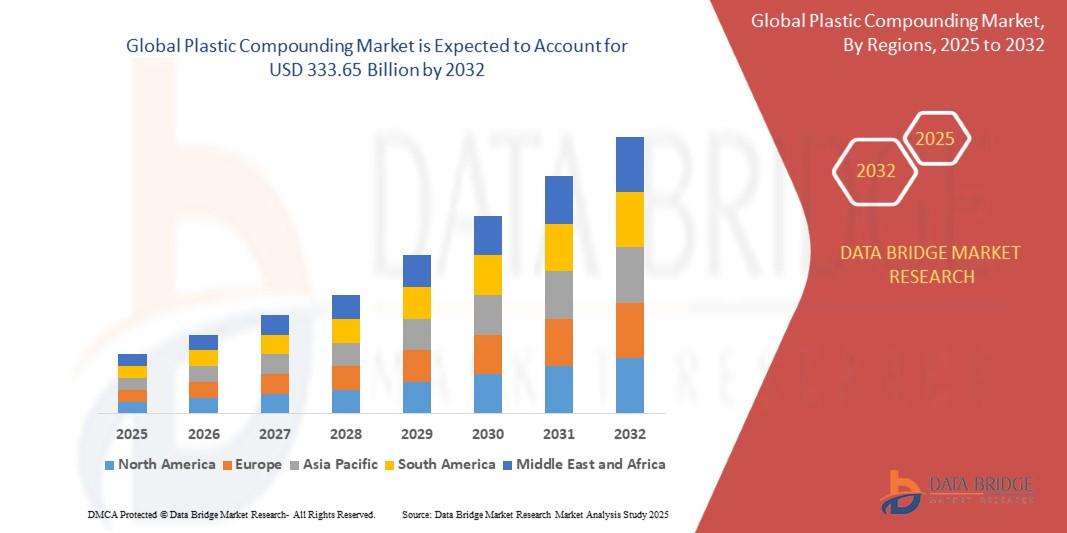
- The global plastic compounding market size was valued at USD 226.24 billion in 2024 and is expected to reach USD 333.65 billion by 2032, at a CAGR of 5.02% during the forecast period by shift towards recyclable and biodegradable plastic compounds due to environmental regulations, advancements in compounding technologies improving product performance and cost-efficiency and supportive government policies and initiatives promoting the use of plastics in various industries
Global market research analysis report gives out a lot for the business and bestows with the solution for the critical or complex business problems. Plastic Compounding Market report displays better market insights with which driving the business into right direction becomes simple and easy. A strong research methodology contains data models that include market overview and guide, vendor positioning grid, market time line analysis, company positioning grid, company market share analysis, standards of measurement, top to bottom analysis and vendor share analysis. For an exceptional business growth, companies must take up market research report service which is imperative in today’s market place.
Stay informed with our latest keyword market research covering strategies, innovations, and forecasts. Download full report: https://www.databridgemarketresearch.com/reports/global-plastic-compounding-market
Plastic Compounding Market Segmentation and Market Companies
Segments
- Based on polymer type, the global plastic compounding market can be segmented into polypropylene, polyethylene, polyvinyl chloride, polystyrene, polyethylene terephthalate, and others. Polypropylene is expected to dominate the market due to its wide range of applications in industries such as automotive, packaging, and construction.
- On the basis of application, the market can be segmented into automotive, electrical & electronics, packaging, construction, consumer goods, and others. The automotive segment is anticipated to witness significant growth, driven by the increasing demand for lightweight materials to enhance fuel efficiency.
- By product type, the market can be categorized into engineering plastics, high-performance plastics, and commodity plastics. Engineering plastics are projected to experience substantial growth owing to their superior mechanical and thermal properties.
Market Players
- LyondellBasell Industries Holdings B.V.
- SABIC
- BASF SE
- Dow
- DuPont
- Solvay
- RTP Company
- Asahi Kasei Corporation
- Mitsubishi Chemical Corporation
- Covestro AG
The global plastic compounding market is highly competitive with key players focusing on strategies such as mergers and acquisitions, product innovations, and strategic partnerships to gain a competitive edge in the market. The market players mentioned above are some of the prominent companies operating in the industry and are actively involved in research and development activities to introduce advanced plastic compounding solutions catering to diverse end-user requirements. The market is also witnessing collaborations between manufacturers and end-users to co-develop customized solutions, further driving market growth.
The global plastic compounding market continues to show resilience and growth prospects driven by various key factors influencing the industry landscape. As the world economy gradually recovers from the impacts of the COVID-19 pandemic, the demand for plastic compounds is expected to witness a steady rise across diverse end-use applications. One of the critical trends shaping the market is the increasing emphasis on sustainability and environmental concerns. Consumers, as well as regulatory bodies, are pushing for the adoption of eco-friendly and recyclable plastic compounds, prompting manufacturers to invest in research and development of biodegradable materials.
Moreover, technological advancements in compounding processes are playing a pivotal role in enhancing the properties and performance of plastic compounds. Manufacturers are increasingly focusing on the development of innovative additive solutions to meet the evolving requirements of end-user industries such as automotive, packaging, and electronics. Customization and formulation of specialty compounds tailored to specific application needs are also gaining traction, enabling market players to differentiate their offerings and capture niche segments within the market.
Another significant aspect influencing the market dynamics is the shift towards lightweight materials in industries like automotive and aerospace to achieve fuel efficiency and reduce carbon emissions. This trend is driving the demand for high-performance engineering plastics that offer a combination of strength, durability, and weight savings. Additionally, the construction sector is witnessing a surge in the use of plastic compounds for applications such as pipes, fittings, insulation, and structural components due to their cost-effectiveness and versatility.
In terms of competitive landscape, the global plastic compounding market is characterized by intense rivalry among leading players striving to maintain their market positions. Mergers, acquisitions, and strategic partnerships are becoming commonplace strategies for companies to expand their product portfolios, geographic presence, and technological capabilities. Furthermore, the focus on sustainable practices and circular economy principles is prompting manufacturers to invest in recycling technologies and closed-loop systems to minimize waste and environmental impact.
Overall, the global plastic compounding market is poised for substantial growth and innovation in the coming years as key industry participants continue to invest in research, development, and collaboration efforts to meet the evolving demands of end-users and regulatory requirements. By staying agile, embracing sustainability, and leveraging technological advancements, market players can capitalize on emerging opportunities and sustain their competitive advantage in this dynamic landscape.The global plastic compounding market is continuously evolving, driven by key factors such as the increasing demand for lightweight materials, advancements in compounding processes, and the growing emphasis on sustainability. The market segmentation based on polymer type, application, and product type highlights the diverse uses and potential growth areas within the industry. Polypropylene's dominance in the market can be attributed to its versatility across various sectors such as automotive, packaging, and construction. The automotive segment is expected to experience significant growth due to the need for lightweight materials to enhance fuel efficiency, which aligns with the overall trend towards sustainability.
Market players in the plastic compounding industry, such as LyondellBasell Industries Holdings B.V., SABIC, and BASF SE, are actively engaged in strategies like mergers, acquisitions, and product innovations to stay competitive in the market. The focus on research and development to introduce advanced solutions and collaborate with end-users for customized offerings underscores the industry's commitment to meeting evolving needs and regulations. The rising consumer and regulatory push towards eco-friendly and recyclable materials is also spurring innovation in biodegradable compounds, reflecting a broader shift towards sustainability in the market.
Moreover, technological advancements in compounding processes are enhancing the properties and performance of plastic compounds, enabling manufacturers to develop innovative additive solutions tailored to specific industry requirements. The customization and formulation of specialty compounds are gaining traction, allowing market players to differentiate their offerings and capture niche segments. The market dynamic of transitioning towards lightweight materials in industries like automotive and aerospace for fuel efficiency and reduced carbon emissions is propelling the demand for high-performance engineering plastics.
Furthermore, the construction sector's increasing adoption of plastic compounds for various applications underscores the cost-effectiveness and versatility of these materials. The competitive landscape of the global plastic compounding market is marked by intense competition among key players vying to expand their market presence through strategic partnerships and acquisitions. Sustainability practices and circular economy principles are driving investments in recycling technologies and closed-loop systems to minimize waste and environmental impact. Overall, the market's trajectory towards growth and innovation hinges on industry players' ability to adapt to evolving trends, embrace sustainability, and leverage technological advancements to meet changing market dynamics effectively.
Frequently Asked Questions About This Report
How does Social Proof influence Plastic Compounding Market purchase decisions?
What percentage of the global food/tech/healthcare economy does the Plastic Compounding Market represent?
How are labels and certifications (e.g., Organic, LEED) driving tech trends?
How do regional dietary/cultural habits influence the Plastic Compounding Market?
How are inventory management systems evolving in the Plastic Compounding Market?
What are the legal barriers to entry in the Plastic Compounding Market?
How are companies in the Plastic Compounding Market using Computer-Aided Design (CAD)?
How is Market Saturation affecting the Plastic Compounding Market industry in North America?
What is the expected IRR for investments in the Plastic Compounding Market?
What will be the market valuation of the Plastic Compounding Market in 2033 if risks are mitigated?
What is the expected exit strategy for Plastic Compounding Market start-ups?
How do trade wars impact the innovation cycle in the Plastic Compounding Market?
Which region leads the global Plastic Compounding Market for niche segments?
Browse More Reports:
North America Automotive Interior Materials Market
Asia-Pacific Beauty Devices Market
Europe Beauty Devices Market
Middle East and Africa Beauty Devices Market
North America Beauty Devices Market
Asia-Pacific Biological Buffers Market
Europe Biological Buffers Market
Middle East and Africa Biological Buffers Market
North America Biological Buffers Market
Asia-Pacific Biometrics in Government Market
Europe Biometrics in Government Market
Middle East and Africa Biometrics in Government Market
North America Biometrics in Government Market
Asia-Pacific Biosensors Market
Europe Biosensors Market
"
- Monuments historiques
- Restaurant Traditionnel
- Образование
- Mode
- Formation
- Information
- Restaurant
- culture
- تسويق
- Tourisme
- سياحة
- تنمية
- Découverte
- Art
- Causes
- Crafts
- Dance
- Drinks
- Film
- Fitness
- Food
- Игры
- Gardening
- Health
- Главная
- Literature
- Music
- Networking
- Другое
- Party
- Religion
- Shopping
- Sports
- Theater
- Wellness
 Russian
 English
 Arabic
 French
 Spanish
 Portuguese
 Deutsch
 Turkish
 Dutch
 Italiano
 Romaian
 Portuguese (Brazil)
 Greek
